

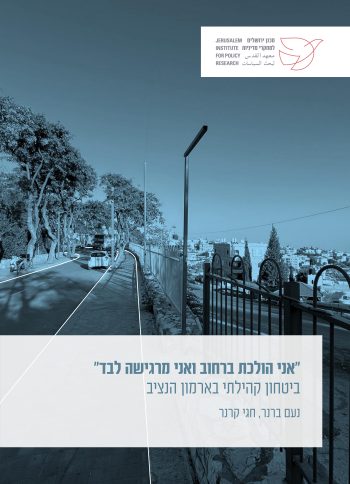
"I walk down the street and feel alone": Community Safety in Armon Hanatziv
Summary
Publication Year: 2025
In Jerusalem, there is daily tension between Jewish and Arab residents, particularly evident in the neighborhoods along the Seam Line. Since 1967, Jewish-majority and Arab-majority areas have coexisted in the city, including neighborhoods where the former urban-national border has become a daily point of transit and encounter. In these neighborhoods, there is mutual dependence between Jewish and Arab residents, alongside national tensions, fear, and uncertainty — dynamics that intensify during times of security crisis. Survey data from 2024 indicate that residents of Seam Line neighborhoods feel less secure than residents of other parts of the city, a trend that deepened after October 7th.
The Armon Hanatziv neighborhood (Talpiot Mizrahi) is one of Jerusalem’s most prominent case studies in this regard. Its geographical location, proximity to the Arab neighborhoods of Jabal Mukaber and Tzur Baher, and shared use of public spaces — promenades, parks, shopping centers — make it a clear lens for understanding how daily encounters between Jews and Arabs shape a sense of security in the urban space. In recent years, models for managing “shared spaces” have been proposed in Jerusalem and other cities. However, after October 7th, civic-urban approaches were often marginalized, giving way to demands for increased security presence and policing.
This document draws on the community security model, which understands security as the product of joint action between municipal institutions, the community, and the police, and which emphasizes residents’ local knowledge and their capacity to identify problems and shape solutions. Building on this framework, the study examines how Jewish residents of Armon Hanatziv define a “sense of security,” how they perceive encounters with the Arab population in the neighborhood’s public spaces, and what solutions — security-related, civic, and communal — they propose to improve the situation.
To explore these questions, the study used a participatory research approach combining field observation and tours, a focus group, a documentary WhatsApp monitoring group, observation of a dedicated community meeting on security, a neighborhood survey of 203 residents, and an analysis of five years of police crime data. The study centers on the perspective of Jewish residents of Armon Hanatziv, aiming to convey their voices authentically, attentively, and respectfully, and to present their difficulties and daily experiences as they themselves interpret them. This choice allows for a deeper understanding of the subjective dimension of security, but also constitutes an important limitation: the perspective of Arab residents who share the same public space is not represented in this study.
The findings reveal a challenging picture: a low sense of security, especially in the evenings and in neighborhood parks; a strong tendency to attribute feelings of threat to the presence of Arab residents in the area; a gap between official crime data and subjective perceptions of risk; and low trust in the municipality and police alongside high trust within the local community. Based on this analysis, the document proposes directions for action – for the neighborhood and for Jerusalem as a whole – and raises the possibility of developing a broader urban model for community security in the Seam Line neighborhoods.
 Download PDF
 Download publication
Projects That Might Interest You
