

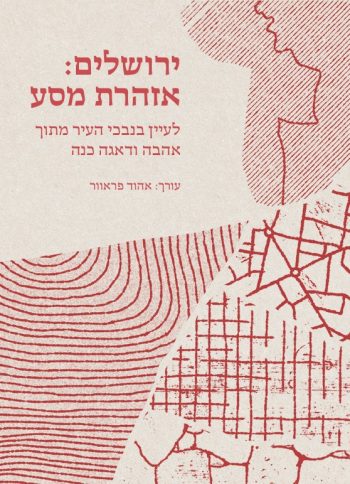
Jerusalem: A Travel Advisory
Summary
Publication Year: 2026
Many believers, in Israel and in the Diaspora alike, dream of being buried in Jerusalem. At the Jerusalem Institute, we choose first and foremost to live and work in this city — to create in it, and to contribute to its development and prosperity. We bring to it a view that is loving, honest, and uncompromising, one that does not shy away from its challenges and difficulties. We do this through applied research that combines the analysis of up-to-date quantitative data with in-depth, incisive qualitative research into the city’s populations.
For 48 years, we have carried the authentic voice of all of Jerusalem’s residents — Jewish and Arab alike — to decision-makers at the municipal and national levels, and to the public at large. We do this without passing judgment on the “voices of Jerusalemites,” and without filtering or softening their power. We believe that in order to address the pain felt by communities living in a “city of many groups” like Jerusalem, we must serve as a faithful mouthpiece for all its residents.
By focusing on Jerusalem, the Institute’s researchers make both a moral and a professional statement: that we must persist — and deepen — our study of the city, even when governmental and international attention drifts elsewhere due to wars and crises. Is applied research by a non-governmental body in a city like Jerusalem a luxury? In my view, it is a necessity. The need for a clear understanding of the basic assumptions and directions guiding both civilian and security policymakers became common wisdom after the massacre of October 7th. This holds especially true for Jerusalem — the primary generator of both peace and conflict in Israel and the Middle East, and the city into which all the internal struggles among Israel’s Jewish “tribes” ultimately drain.
For this reason, we have chosen to present, in this book, a “travel advisory” for Jerusalem. The book carries both hope and a dream for the city’s future, alongside “red flags” — warnings about troubling trends that deserve deeper examination and root-level solutions. This is not a book that despairs of Jerusalem. On the contrary — against a despair that has spread widely among the public, we seek, through this book and the Institute’s broader research, to offer a credible and hopeful alternative. The book brings together the Institute’s leading researchers and their core analyses of the city and its future.
 Download PDF